 |
Peter Blinn |
 Peter Blinn
Some notes on the wide-flange beams seen in 10-debris.avi |
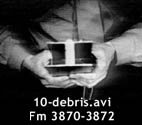  Let me offer a few
observations on the characters visible in strong relief on both sides of the
webs of the two wide-flange beams on segment 10-debris.avi, and allow you to see
some enhanced views of them so that you may come up with some of your own
ideas. Let me offer a few
observations on the characters visible in strong relief on both sides of the
webs of the two wide-flange beams on segment 10-debris.avi, and allow you to see
some enhanced views of them so that you may come up with some of your own
ideas.First let's look at the larger of the two beams, one end of which you can see to the right. As on the smaller beam, the web gives the appearance of penetrating beyond the top flange slightly to form a half-round, but the bottom flange is perfectly flat. As far as can be seen, the section through the flanges and the web is completely solid. You'll see four views of the characters below. To gather as much resolution and to average away as much of the noise from the footage as possible, on each of these four views I: (1) Superimposed five consecutive hi-res frames, aligning them to cancel out their camera movement. (2) Ran a mild high-pass filter through the resulting composite to minimize the web's large scale brightness gradations. (3) Reduced the vertical resolution by about half -- by first downsampling the height of the image and then expanding it back out -- to soften the scan line grain. (The true vertical resolution of a video image is substantially cruder than its horizontal resolution anyway, so we're not sacrificing anything by doing this.) (4) And finally boosted the contrast and added numerals for reference. 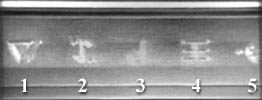 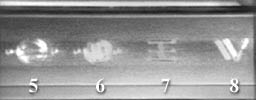 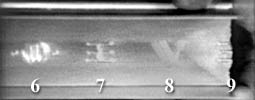 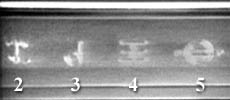 The closeups on the first row derive respectively from 10-debris.avi frames and . Those on the second, from and from . That bright horizontal band along the top of each image is the half-round aligned with the web's plane. As you can see by looking at the moving footage, these beams are extremely shiny -- almost mirror-like. This makes it tough to discern some of these characters, especially numbers 2 and 3. Judging from what I can see elsewhere in the footage as the beam moves about, Character 3 looks exactly like a lowercase Roman D but Character 2 betrays little more beyond the muddle that you see here -- a downstroke with jiggly, arc-shaped features at each end. I have many dozens of alphabets, syllabaries and ideographic writing samples at my disposal, both ancient and modern -- and a pretty decent visual memory for at least a few of them besides -- against which to compare these characters. Nakhi picture writing? Got it. Tifinagh, Pyu, Khotanese, Bugis, Batak, Lepcha, Palmyrene and Micmac? No problem. Although some observers have described these glyphs as appearing Cyrillic I can at least put that firmly to rest. They bear no meaningful resemblance to any classic or contemporary Cyrillic alphabet or anything even associated with that genre which takes in Glagolitic, Georgian (both Church and Civil) and Armenian. Taken collectively, they resemble no writing system I've ever examined. Now inevitably some of the characters IN ISOLATION will look familiar, though with such a minuscule sample it probably doesn't pay to jump the gun. Some of you may have heard of the Bat Creek Stone, for example, which was discovered in 1889 in Tennessee. It displays seven rather casually graven patterns which, depending on whose manifesto you take to heart, might be interpreted as Iron Age Canaanite, or runes of some sort, or even Cherokee. I'd be surprised if the Mormons haven't weighed in on it. Conservative researchers tend to dismiss it as a hoax. The big problem that the Bat Creek Stone and these wide-flanges share in common is the limited number of characters. Dozens or hundreds might do us a world of good; a handful serves us little better than a clutch of tea leaves. There are still some interesting things to note, though.  Character 4 occurs at
least three times, including at the far right end where the original beam breaks
through it (Position 9). It closely resembles the Phoenician character for a
special S sound ( Character 4 occurs at
least three times, including at the far right end where the original beam breaks
through it (Position 9). It closely resembles the Phoenician character for a
special S sound ( ) which
ultimately evolved into the modern Hebrew letter samekh ( ) which
ultimately evolved into the modern Hebrew letter samekh ( ). It's also the ancient
Ionian/Corinthian character for KS, which as a modern uppercase Greek xi ( ). It's also the ancient
Ionian/Corinthian character for KS, which as a modern uppercase Greek xi ( , actually pronounced "ksee") retains
those horizontals but shrinks the middle one and loses the downstroke. Third,
it's the H character from the alphabet used to express the tonal Bassa language
in Liberia. And by George if it doesn't also happen to be the astrological
glyph for asteroid 1541 Estonia. , actually pronounced "ksee") retains
those horizontals but shrinks the middle one and loses the downstroke. Third,
it's the H character from the alphabet used to express the tonal Bassa language
in Liberia. And by George if it doesn't also happen to be the astrological
glyph for asteroid 1541 Estonia.The Saturn-like Characters 5 and 6, though, distinguish themselves by NOT resembling much of anything earthly, and it's additionally curious that they both show those small projections -- which I interpret as dots -- at their sides. Ignoring the dots, a single horizontal bar would make us think of a Greek theta, but it seems clear that each sports TWIN bars with the version on the right rotated to near vertical. I'm also struck by the clever transformation between Characters 1 and 8. In the former the triangle is closed and the "slash" falls to the right; the latter mirrors this configuration left-to-right and also breaks open the triangle to remind us of a Roman numeral four.  Cleverer still is a character visible on
the smaller beam which I show transcribed to the left. It's an equilateral
triangle defined by two parallel lines and a dot -- the sort of thing a graphic
designer might automatically think of, but extremely atypical of any earthly
writing. Two other characters show on the small beam: a circular figure that resembles an
uppercase Roman Q with a raised dot in the center and a radial, star-like
figure. The star shows only from a grazing angle and only fleetingly. Cleverer still is a character visible on
the smaller beam which I show transcribed to the left. It's an equilateral
triangle defined by two parallel lines and a dot -- the sort of thing a graphic
designer might automatically think of, but extremely atypical of any earthly
writing. Two other characters show on the small beam: a circular figure that resembles an
uppercase Roman Q with a raised dot in the center and a radial, star-like
figure. The star shows only from a grazing angle and only fleetingly.My feeling is that the beams we're seeing in this film are either the product of a pretty sophisticated hoax or are extraterrestrial artifacts; I can't conceive of either of them simply being some unidentified "foreign" script on a random piece of hardware. In general once you move beyond the Roman, Greek and Cyrillic alphabets, the remaining scripts on this planet tend to be relatively freeform in character. Having arisen to accommodate the limitations of human hands and simple writing tools, they're not, as a rule, inclined to be so geometrical and mechanistic as what we see here. Plus, let's face it, any earthly script so impenetrably obscure as this one, presumably moldering among long-forgotten books or scrolls or temple ruins and known only to a handful of specialists, could scarcely be expected to show up on a modernistic wide-flange beam. 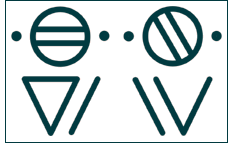 If this is a
hoax or a stage prop, it took substantial resources. The characters are not
incised but instead stand out in relief, which means they would first have had
to have been carved into both sides of a mold (or formed through a lost wax
process), from which the web would then be cast. Designing and operating a
two-piece mold like that is no trivial chore. One could sidestep it by casting
two one-sided webs and then laminating them back-to-back, but as we've already
noted the piece is monolithic. If not cast, the web could alternatively have
been struck, like a coin, in a die under tons of pressure; but here again this
is hardly a job you'd knock off in your garage on a Saturday afternoon. However
fabricated, the web and the flanges would have to be given that marvelous
specular polish and then assembled exquisitely enough to hide the joints. Using
some softer, non-metallic material would save a lot of trouble, though that
finish would then have to be applied artificially. Moreover the beams in the
film DO appear to exhibit some heft, as lengths of metal really would, in the
smooth way they move as the presenter tilts and rotates them and in the way the
flesh of his hands responds to the mass. One would expect something far less
dense -- say injected urethane or balsa -- to bounce and jiggle much more freely
than that. If this is a
hoax or a stage prop, it took substantial resources. The characters are not
incised but instead stand out in relief, which means they would first have had
to have been carved into both sides of a mold (or formed through a lost wax
process), from which the web would then be cast. Designing and operating a
two-piece mold like that is no trivial chore. One could sidestep it by casting
two one-sided webs and then laminating them back-to-back, but as we've already
noted the piece is monolithic. If not cast, the web could alternatively have
been struck, like a coin, in a die under tons of pressure; but here again this
is hardly a job you'd knock off in your garage on a Saturday afternoon. However
fabricated, the web and the flanges would have to be given that marvelous
specular polish and then assembled exquisitely enough to hide the joints. Using
some softer, non-metallic material would save a lot of trouble, though that
finish would then have to be applied artificially. Moreover the beams in the
film DO appear to exhibit some heft, as lengths of metal really would, in the
smooth way they move as the presenter tilts and rotates them and in the way the
flesh of his hands responds to the mass. One would expect something far less
dense -- say injected urethane or balsa -- to bounce and jiggle much more freely
than that. |
|
Peter Blinn |
Home